
Agent Alexander Elijah Barber had been awake for fourteen hours, although he insisted it was technically only three because “internet time operates differently.”
His mission sounded simple enough: identify the owner of a lawful adult website.
The website was not hiding. It had a corporate name, public representatives, contact information, legal notices and enough paperwork to smother a medium-sized horse.
But Alexander did not trust paperwork.
Paperwork, he believed, was exactly what paperwork wanted him to trust.

Alexander stood before his evidence board wearing sunglasses indoors and a beige trench coat that still had the store tag tucked beneath one sleeve.
Red string connected screenshots, usernames, registration records, pizza receipts, maps and a photograph of a pigeon that had been looking at him with what Alexander described as “unusual confidence.”
His partner Paul entered carrying a thick folder.
Paul: “I found the corporate registration. It identifies the company.”
Alexander slowly removed his sunglasses.
Alexander: “That is what they want you to think.”
Paul: “It is a government record.”
Alexander: “Exactly.”
Paul opened the folder.
Paul: “There are also interviews with the operator, archived versions of the website and legal documents naming the same people.”
Alexander: “Too consistent.”
Paul: “What does that mean?”
Alexander: “Coordination.”
Paul: “Or accuracy.”
The Facts Become Uncooperative
The trouble with the investigation was not that evidence was missing.
The trouble was that every verifiable document kept pointing toward an ordinary explanation.
The website appeared to be operated through a conventional business structure. Public records supported that conclusion. Available material did not reveal a secret intelligence network, a shadow-government operation or an international cabal of suspiciously organized accountants.
Alexander found this deeply unsatisfying.
Alexander: “A normal company? That cannot be the ending.”
Paul: “It may be the ending.”
Alexander: “There has to be something larger.”
Paul: “Why?”
Alexander: “Because I bought this coat.”
They had reached the most dangerous stage of an online investigation: the moment when the original theory failed, but the investigator had already built an identity around being correct.
Alexander stared at the board.
Alexander: “What if the documents are fake?”
Paul: “Do we have evidence that they are fake?”
Alexander: “No.”
Alexander: “What if the interviews were staged?”
Paul: “Do we have evidence of that?”
Alexander: “No.”
Alexander: “What if the owner is actually three children standing on one another’s shoulders?”
Paul: “Alexander.”
Alexander: “Fine. Two children and a retired magician.”
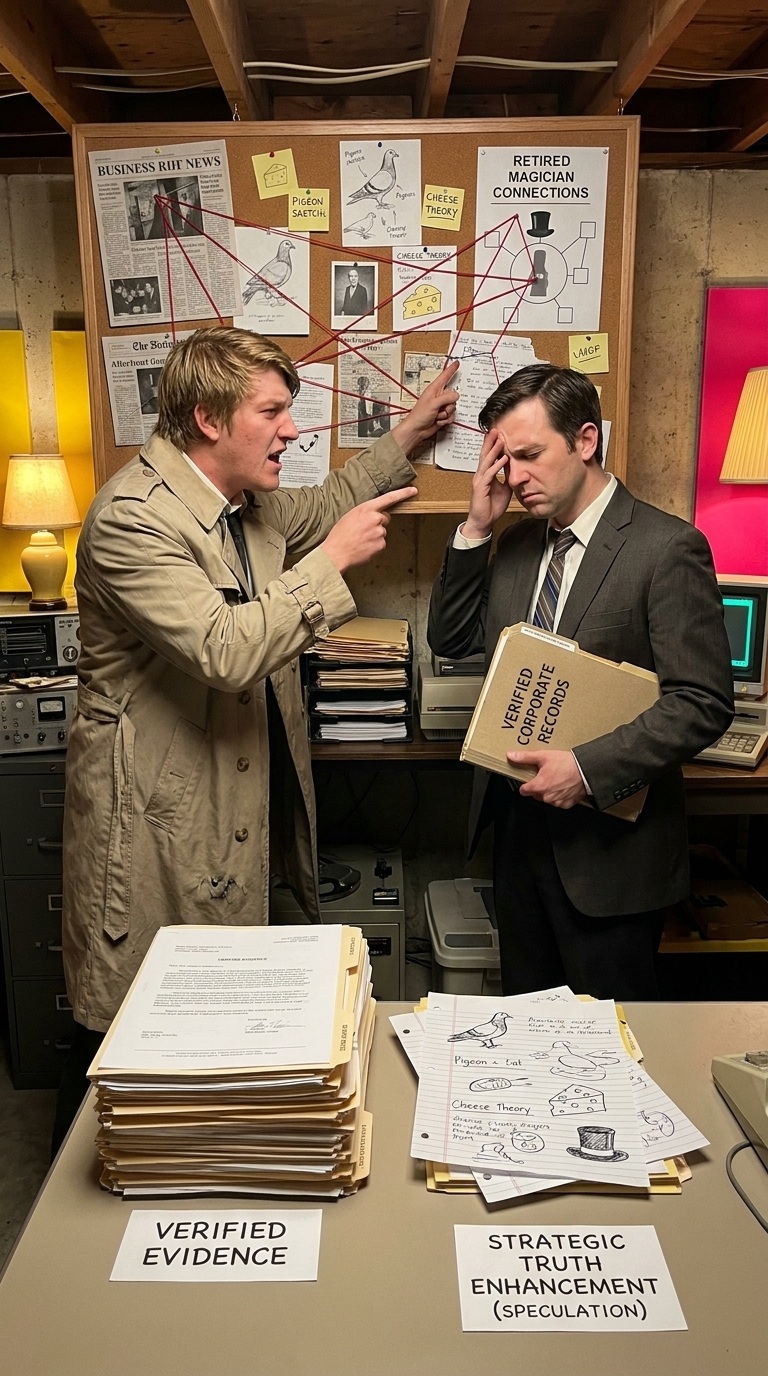
Paul placed the documents into two piles.
Verified Evidence
Corporate registrations, archived pages, legal records and statements that could be checked independently.
Speculation
Anonymous comments, assumptions, dramatic guesses and several pages of Alexander’s handwriting.
Magician File
No supporting evidence. Surprisingly elaborate diagram. Rejected by Paul.
Paul: “This pile contains what we can prove. This other pile contains speculation.”
Alexander: “Perhaps evidence itself has become compromised.”
Paul: “Evidence cannot become compromised just because it disagrees with you.”
Alexander lowered his voice.
Alexander: “Then perhaps we must create stronger evidence.”
Paul: “Create it?”
Alexander: “For the greater good.”
Paul: “That is called making things up.”
Alexander: “Only when villains do it.”
Paul: “And when heroes do it?”
Alexander pointed dramatically at the board.
Alexander: “Strategic truth enhancement.”
The Hero Exception
The Hero Exception is an unwritten rule of bad internet reasoning.
It says that if you believe you are fighting something evil, ordinary standards no longer apply to you.
Rumours become leads. Guesses become facts. Anonymous comments become witnesses. Missing evidence becomes proof that somebody removed the evidence.
The investigator stops asking, “Is this true?” and begins asking, “Would this help my side?”
Alexander began dictating.
Alexander: “Write this down: sources close to the investigation suggest—”
Paul: “What sources?”
Alexander: “We are close to the investigation.”
Paul: “That makes us the sources.”
Alexander: “Excellent. Plural.”
Paul put down his pen.
Paul: “No. We cannot invent facts because reality is less exciting than your theory.”
Alexander: “But we are the heroes.”
Paul: “Every person making things up online thinks that.”
The room became quiet.
Even the pigeon photograph seemed disappointed.
When the Mission Consumes the Agent
The disagreement with Paul should have been Alexander’s signal to stop.
Instead, he spent another night reading arguments, refreshing notifications and drawing connections between strangers who had never heard of him.
The basement slowly filled with pizza boxes, empty cans, dirty clothes and discarded printouts. The trench coat remained nearby, but it no longer looked like the uniform of an international operative.
It looked like a costume abandoned on the floor.
For the first time, Alexander saw the room without the dramatic soundtrack playing in his head.
There was no command centre.
There was no intelligence agency.
There was only a tired man sitting in a family basement, surrounded by cold food, glowing screens and theories that had taken more from his life than they had ever given back.

Becoming overwhelmed by constant internet use does not make someone hopeless, ridiculous or beyond help.
It may mean that sleep, ordinary routines, offline relationships and outside perspective have been pushed aside for too long.
Cut to: The Therapist’s Office
In the fictional therapist’s office, there was no evidence board.
There were no red strings, coded cheese photographs or maps with circles around countries Alexander had never visited.
There were two chairs, a small table and a clock that Alexander suspected was running three minutes fast.
The therapist did not call him stupid. She did not mock him for becoming overwhelmed. She did not reduce his entire personality to an insulting label.
She asked how much time he had been spending online.
Alexander: “Researching?”
Therapist: “Online.”
Alexander: “Define online.”
Therapist: “Using the internet.”
He sighed.
Alexander: “Most of the day.”
Therapist: “And at night?”
Alexander: “Night is when the Americans are active.”
Therapist: “How much sleep are you getting?”
Alexander looked toward the suspicious clock.
Alexander: “Sleep creates intelligence gaps.”
Therapist: “What happens when you try to stop researching?”
Alexander: “I feel like something important will happen without me.”
Therapist: “And what usually happens?”
Alexander: “People argue.”
Therapist: “Does the argument require you?”
Alexander considered this carefully.
Alexander: “They would argue incorrectly.”
Therapist: “That may still happen while you are asleep.”
The idea that the internet could continue being wrong without his supervision had apparently never occurred to him.
The Conspiracy Machine
The internet rewards certainty, urgency and outrage.
A calm statement such as the records point toward an ordinary corporate owner rarely travels very far.
A headline screaming SECRET OWNER EXPOSED IN INTERNATIONAL PIGEON OPERATION has considerably more potential.
The human mind can begin adapting to that reward system.
Every notification feels important. Every disagreement feels like a challenge. Every coincidence begins to resemble a clue. After enough hours online, uncertainty can become unbearable.
That does not mean a person is hopeless.
It may mean the person needs distance, rest and another human being who is not participating in the same feedback loop.
Operation: Log Off
The therapist did not tell Alexander to destroy his computer or abandon every subject that interested him.
Instead, they discussed smaller steps.
- Sleep before publishing.
- Separate verified information from interpretation.
- Ask what evidence would change his mind.
- Stop treating disagreement as evidence of infiltration.
- Take regular time away from screens.
- Reconnect with ordinary routines, friends and outdoor life.
- Speak to a therapist, doctor or trusted person when internet use begins consuming everything else.
Reaching out for help did not mean surrendering the mission. It meant bringing in backup.
Sometimes the bravest move available to the self-appointed hero is admitting that he no longer knows which parts of the story are supported by evidence.
Alexander looked down at his shoes.
Alexander: “Paul says I have become difficult to work with.”
Therapist: “What do you think?”
Alexander: “I think Paul may have been replaced.”
The therapist waited.
Alexander exhaled.
Alexander: “Or he may simply be tired of me.”
Therapist: “That sounds possible.”
Alexander: “He also said we cannot make up evidence.”
Therapist: “That sounds responsible.”
Alexander: “It ruins the story.”
Therapist: “It may save the truth.”
The World Outside the Basement
The first day offline felt uncomfortable.
Alexander kept reaching toward his pocket whenever he imagined a new notification. He wondered what arguments were unfolding without him and whether somebody, somewhere, was being wrong in an especially urgent manner.
By the second day, he slept.
By the third, he noticed that summer had arrived.
The sky was blue. The trees were green. People were sitting at picnic tables without discussing secret website ownership, retired magicians or administrative-looking clouds.
Nobody asked him to infiltrate anything.
Nobody needed an emergency thread.
He walked through the park wearing a white shirt and blue shorts. His phone remained switched off inside his bag.
For once, the silence did not feel like an intelligence gap.
It felt like peace.

Back at Headquarters
When Alexander eventually returned to the basement, Paul was already sitting at the table.
Alexander removed the pigeon photograph. Then the cheese diagram. Then the theory involving the retired magician.
Paul: “What are you doing?”
Alexander: “Reducing operational clutter.”
Paul: “You are taking down the nonsense?”
Alexander: “I am declassifying it into the recycling bin.”
Paul held up the corporate documents.
Paul: “So we publish only what we can support?”
Alexander nodded.
Paul: “And when we do not know something?”
Alexander: “We say we do not know.”
Paul: “And we do not invent a source?”
Alexander hesitated.
Alexander: “Not even a highly placed anonymous sandwich?”
Paul: “No.”
Alexander: “Fine.”
The mission had changed.
They were no longer trying to force the facts into an exciting story.
They were trying to let the facts remain facts.
It was less cinematic.
It was also the first genuinely professional thing they had done.
Somewhere outside the basement, the pigeon flew away—unconnected to the government, the website or anything else.
Probably. Maybe. Birds are the perfect cover for a government spy drone…